
Lead Times in Panel Supply: 2 to 10 Weeks After Deposit
A quoted lead time is the clearest signal of how a supplier is organised. Dongstar states two to ten weeks from order confirmation plus deposit on as standard its structural panel page, which is 14 to 70 days of production and documentation. That window is long enough to plan around and short enough to be worth checking against the 20-ft container minimum that applies to wholesale orders on the same page.

Key takeaways
- Two to ten weeks runs from order confirmation and deposit, so the clock starts on the payment date, not on the enquiry.
- Wholesale and bulk orders normally start at one 20-ft container or the equivalent volume, negotiable on larger projects.
- Packing is palletised, wrapped and trucked into containers at port; the mill can book freight or work with the buyer's forwarder.
- Certificates such as FSC, CE and E0/E1 formaldehyde documentation are supplied on request, so they belong in the same schedule as production.
What the two-to-ten-week window actually contains
Fourteen days and seventy days are not the same promise, and the difference is not only factory load. The window covers pressing, trimming, edge work, quality checks, palletising, documentation and inland transport to port. A standard size and grade on a low-complexity specification can sit at the front of that range. A non-standard size, a special face or a branded packing plan sits further back, because each of those adds a setup step before the press is committed.
The useful way to read the statement is as a planning band rather than a delivery date. Buyers who build a project programme around the far end of the band, ten weeks, find that an earlier shipment is a gain, while buyers who plan on two weeks and receive a normal eight-week run have to rebook labour and storage. The same page describes scheduled shipments on long-term contracts, which is how repeat buyers convert the band into a rhythm of deliveries.
One container is the wholesale entry point
The structural page puts the usual minimum for wholesale and bulk orders at one 20-ft container or an equivalent volume, negotiable on substantial projects. That figure is more useful than it first appears, because it tells a buyer whether the enquiry is a production run or a sample order. A specification that fits well inside one container is also the specification that avoids paying for a load that is heavy on paperwork and light on volume.
For project buyers, the container figure and the lead time work together. A programme that needs three separate deliveries can be planned as three container loads spread across the band, with the first shipment confirmed early enough to test the specification on site before the remaining volume is pressed. That sequencing is one of the reasons the page frames itself around project work rather than spot sales.
Why the panel specification behaves as it does on site
The same page explains the construction that justifies the project framing. A cross-laminated veneer structure raises bending strength and dimensional stability, resists warping and distortion, and holds the panel flat under pressure — the property that decides whether a formwork face stays true through repeated use. Against that sits a Doka-grade structural plywood build, described as processed so that it can be reused a high number of times, with a smooth, even concrete face that cuts secondary plastering and finishing work on the finished surface.
Those two statements matter to scheduling because they set how many pours one set of panels can carry. A buyer who expects a high reuse count can plan fewer panel sets per project and fewer mid-programme replacement orders. A buyer who ignores the point budgeted for replacements will spend the middle of the programme chasing panels that are not on the shipping schedule.
Packing, port handling and who books the freight
Packing is stated as palletised and wrapped, then trucked into containers at the port. For a project buyer this is a specification item rather than a formality: pallet dimensions decide how many panel packs fit in a container, and incomplete packing decisions at the quotation stage are what turn a settled lead time into a revised one. The page also notes that the mill can book freight on the buyer's behalf or accept the buyer's own forwarder, which is the practical difference between two buyers on the same price list.
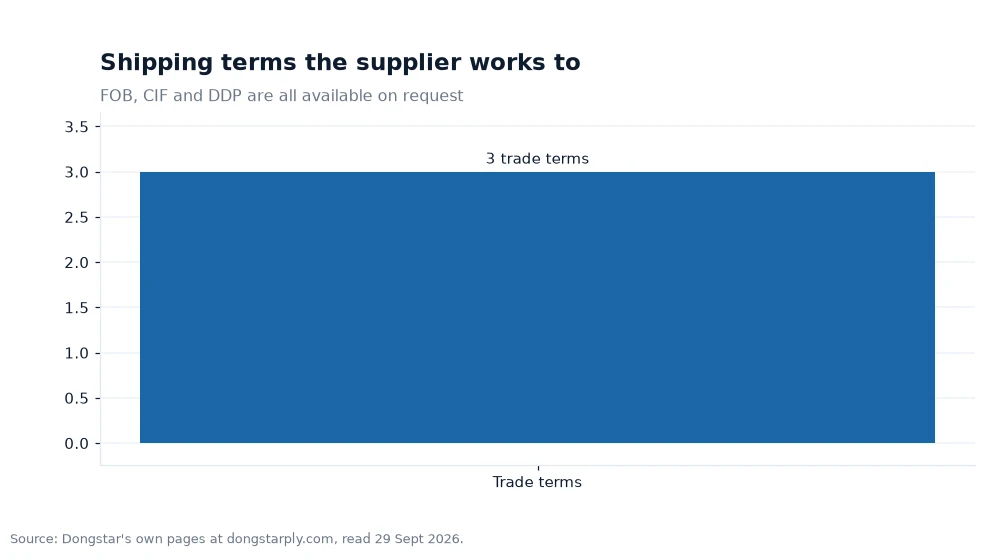
Trade terms on the same page are FOB, CIF and DDP. Those three shift who arranges carriage, insurance and import clearance, and therefore which party is exposed when a port is congested. A buyer who chooses terms before confirming the production window can end up with panels ready at the factory and no agreed route to site.
| Item | Published statement | Planning consequence |
|---|---|---|
| Lead time | 2–10 weeks after order confirmation and deposit | 14–70 days to programme; schedule from the deposit date |
| Minimum order | Usually one 20-ft container, or equivalent, for wholesale | Sets the smallest economic production run |
| Packing | Palletised, wrapped and trucked to port | Decides container fill and handling at destination |
| Trade terms | FOB, CIF and DDP available | Changes who books carriage and carries risk |
| Certificates | FSC, CE and E0/E1 formaldehyde certificates on request | Needs to be queued with the production slot |
Worked example: fitting a shipment window to a pour programme
Suppose a concrete programme pours one section every three weeks, and the panels need to be on site before each pour (example schedule). Three weeks is 21 days. A shipment that lands at the near end of the published window, 14 days, is ready for the first pour with a week spare. A shipment at the far end, 70 days, covers 70 ÷ 21 = 3.33 pour cycles, so the first three sections can be planned with the panels already counted in.
Run the same numbers against a two-week delivery claim instead. If a supplier promises ten days and the real position is the far end of the band, the gap is 70 − 10 = 60 days, almost three pour cycles of slippage (example arithmetic). That is the reason the published band is worth more than a short verbal estimate: the buyer can see the worst case, price the storage, and decide whether to split the order across two shipments instead.
Frequently asked questions
When does the lead time start counting?
From order confirmation and deposit, according to the published statement on the structural panel page. The enquiry, the sample request and the quotation stage sit outside the window, which is why a slow internal approval process can consume more calendar time than production does.
Can a smaller first order be placed?
Wholesale and bulk orders normally begin at one 20-ft container or the equivalent volume, and the page notes that larger projects are negotiable. Buyers below that threshold usually consolidate families into a single mixed container rather than splitting the enquiry into several small lots.
Do certificates affect the delivery date?
They can. FSC, CE and E0/E1 formaldehyde certificates are provided on request, so a certificate set that has to be issued alongside a specific batch belongs in the same production schedule as the panels themselves rather than being requested after the goods are packed.
Where to take the enquiry next
Buyers who need the production framing in more detail can read the background on the manufacturing group and the standards work it takes part in, then compare the structural sheet against the wider catalogue on the panel range overview. Writing the enquiry as a 3 Layer Plywood project brief, with sizes, quantities and the required month of shipment, is what converts a two-to-ten-week band into a working delivery plan.
Lead times, minimum order quantities, packing and trade terms above are published on the maker's own website, reviewed on 29 September 2026, and used throughout these notes[1].